
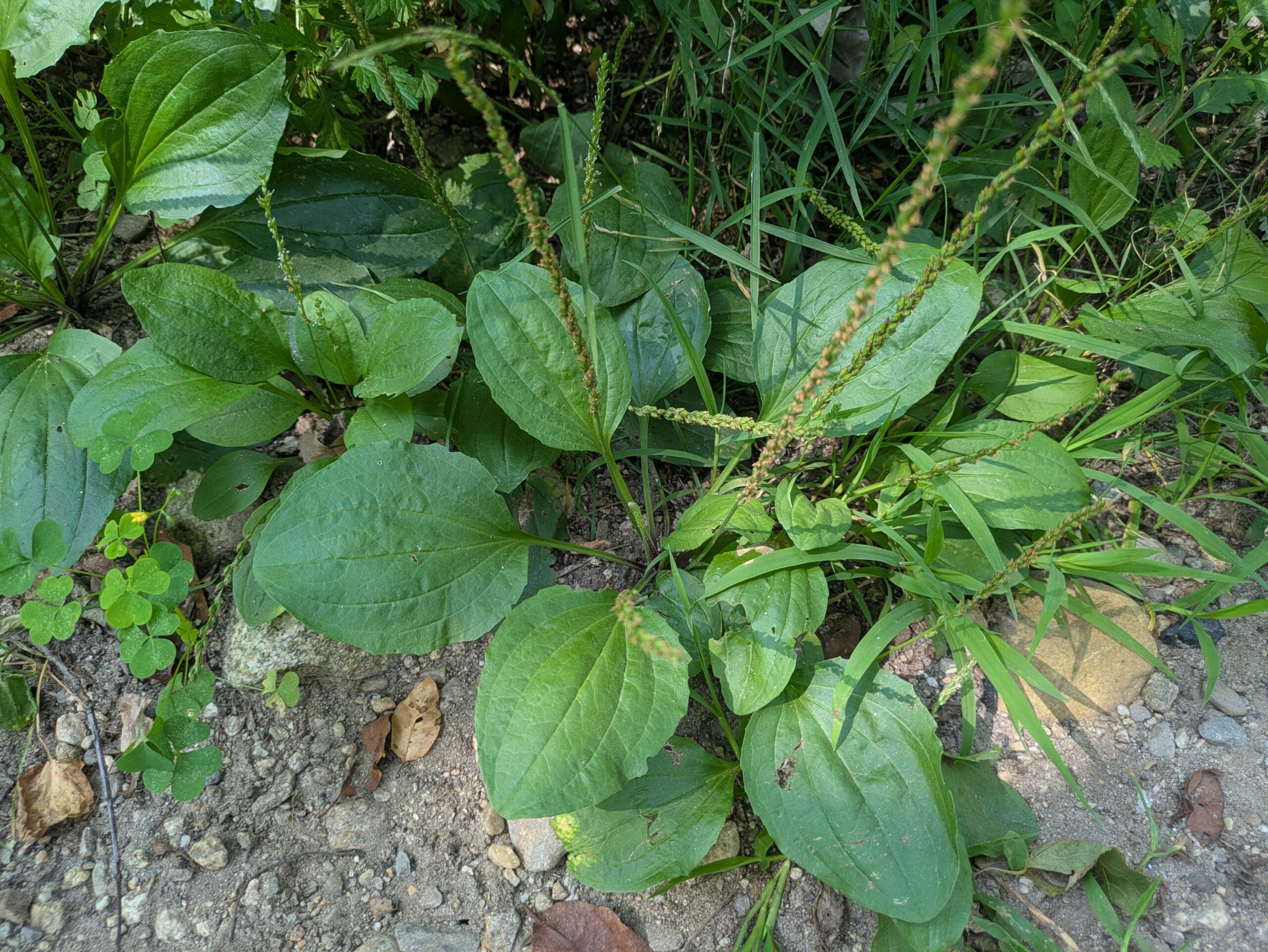
Any time I hear someone ask me, “What’s the one herb you would want to have with you if you were lost on a deserted island?” my answer is almost always going to be Plantain. And no, that’s not a big starchy banana.
There are three varieties of plantain species you’re likely to find in the Americas: Plantago major, Plantago lanceolata, and Plantago rugelii.


Plantago major and lanceolata were introduced here with European colonizers and naturalized so quickly that Native peoples began calling it “White Man’s Footprint,” because it seemed to grow anywhere white men settled and in all the hard, compacted soil of their roadways and footpaths.
This little plant is so ubiquitous I am certain that if you live in a temperate climate, you have seen it before (probably growing in a crack in your driveway.) I’m honestly astounded when I come across a property that has no plantain in sight, though that has only happened maybe twice in all my years of teaching foraging.
It’s a darn good thing you can find this everywhere too, because it’s a plant with many medicinal qualities that can benefit just about any human on earth.
Plantain’s medicinal actions include:
- Anti-inflammatory
- Antibacterial
- Antiseptic
- Anticattarrhal
- Astringent
- Demulcent
- Expectorant
- Vulnerary
What that means in layman’s terms is that the leaves of this plant are amazing at healing wounds of all kinds both inside and outside the body, and that it can help treat a cough. I’ve also made plantain into a mouthwash to improve gum health, as it may help heal an abscess or a gum or tooth infection.
Plantain is the first medicinal plant I taught my children about (second only after teaching them how to identify poison ivy) and is usually one of the first ones we start off with on most foraging walks that I teach. Why? Because it’s so easy to find and works SO quickly!
What do I do with it?
First off I’d like to mention that plantain is edible. It’s slightly mucilaginous, which means it kind of creates a goopy mess inside your mouth when you’re chewing it. And it’s not particularly delicious. But if it’s early spring and you’re dying to eat the first green thing you see, it will do in a pinch.
The easiest way to work with plantain medicinally is as a spit poultice. That means after you get stung by a bee or bitten by a mosquito (or whatever) you pick a plantain leaf, chew it up in your mouth, then put the mushy plant material onto the area that was bitten. Do your best to leave it there for at least a few minutes. You will notice the pain and itchiness begin to subside within just a minute or two!
Note: All varieties of plantain leaf can be used interchangeably
I have also heard another herbalist talk about how plantain can draw poisons from a spider bite or potentially even a snake bite. While I would certainly urge you to get to a hospital if you are bitten by something dangerous, it certainly wouldn’t hurt to put a plantain poultice on the bite mark before you get in the car.

Plantain leaf is one of the lead ingredients in my Bellyrama Tea, which can potentially help heal your gut lining over regular daily use. This is due to plantain’s vulnerary properties— it can help heal the wounds inside your digestive tract (such as leaky gut) the same way it heals the skin on your arm.
It’s also worth noting that the seeds from Plantago major are also known as Psyllium husk, and have been used as a stool bulking agent for many years. That means it can (in the right dosage) help you poop!
Plantain makes a nice addition to a tea blend (or can be drank on its own) to help expectorate mucus from your lungs while simultaneously moistening a dry respiratory tract.
We’re going to explore more about plantain and make it into several different medicinal preparations during my No BS Herb School for next year.
If this class goes well, I’ll offer multiple cohorts for next year. Learning how to sustainably forage and work with medicinal plants over the course of a season MUST be taught in person. You can’t build comprehensive intuitive plant knowledge without some in-person physical application. I can’t wait to see how we grow together!