
You probably know by now that I love birch trees, because birch bark is a phenomenal herbal pain reliever. But what are the differences among the various varieties of birch trees? Let me tell you what I have personally experienced and you can make the final decision.


The first time I ever worked with Birch bark medicinally was about 8 years ago. I heard somewhere on the internet that birch contained a salicylate compound. I knew there was a paper birch tree in my mom’s backyard so I went there when she wasn’t home and discreetly peeled a handful of bark off the trunk. [Note: I would never do this now as I don’t want to open the inner bark up to potential infection, but white birch is the easiest to peel if you need to do so.]
I ripped the bark up, shoved it into a glass jar, and covered it with cheap olive oil. Six weeks later, I was standing at my kitchen counter straining the bark out and accidentally dripped some out of the jar. Not wanting to waste it, I wiped it up with my hand and rubbed it on my lower back, where I’d been experiencing pain for months. Then I went back to cleaning up the mess and washing the jar.
Within about two minutes of applying birch oil, I turned to get something from the other side of the kitchen and realized that my back pain was GONE.
Holy shit, I thought. This stuff really works!
After that, of course, I used birch oil for every kind of pain I had. Any time a family member had pain I’d toss a bottle of birch oil at them and say “You won’t believe how well this works!” I also began using much higher quality olive oil and other ingredients to make my herbal products the better I got at making them.
Eventually, I realized the one tree in Mom’s yard wasn’t going to be enough for me to keep making this, so I began exploring other options.
Unfortunately, over the last 40 years or so, white birch trees have fallen susceptible to the Birch Borer Insect and as a result the population is a fraction of what it once was. I recall staring out the window for many hours on long road trips as a child, watching the multitudinous white birch trees sweep past my window along the roadways everywhere we drove in New England. It’s sad to see so few of them left in the wild now.

In one respect, this fact is somewhat helpful actually; Birch Polypore mushrooms grow mainly on dead or dying white birch trees, so I’ve had no shortage of them to forage. They make an excellent substitute (medicinally) for Chaga, which is much harder to find this far south.
Two important medicinal mushrooms, chaga and birch polypore, both grow exclusively on birch trees. The only times I have found Chaga on my own in the wild it was growing on Grey Birch.
How to Identify and Harvest Black Birch
After a few hiking trips I discovered that I was living in the dead center of the growing range for Black Birch (Betula lenta.) These are sometimes called Sweet Birch trees, and are the variety most commonly associated with old-fashioned toothbrushes (partly due to the flavor and partly because of their natural Xylitol content). There are literally thousands of them on almost every hiking trail I go to regularly, and they have since become my favorite tree.

As any Herbalist knows, Winter time is the ideal season to harvest bark for most trees. This is because in the winter, the tree is dormant. You don’t want to harvest bark AT ALL in the spring time, but instead allow the tree to put its energy into growing new leaves and buds.
Technically speaking, the PERFECT time of year to harvest is February and March, coinciding with Maple Syrup season. If the Maple sap is running, so is the birch and other deciduous trees! You can also tap birch trees but aside from trying out Birch water as a survival tactic or novelty, the sugar ratio is far too low to be worth trying to make any kind of syrup with it.
How do you find black birch if you don’t already know what to look for? The Scratch and Sniff Test

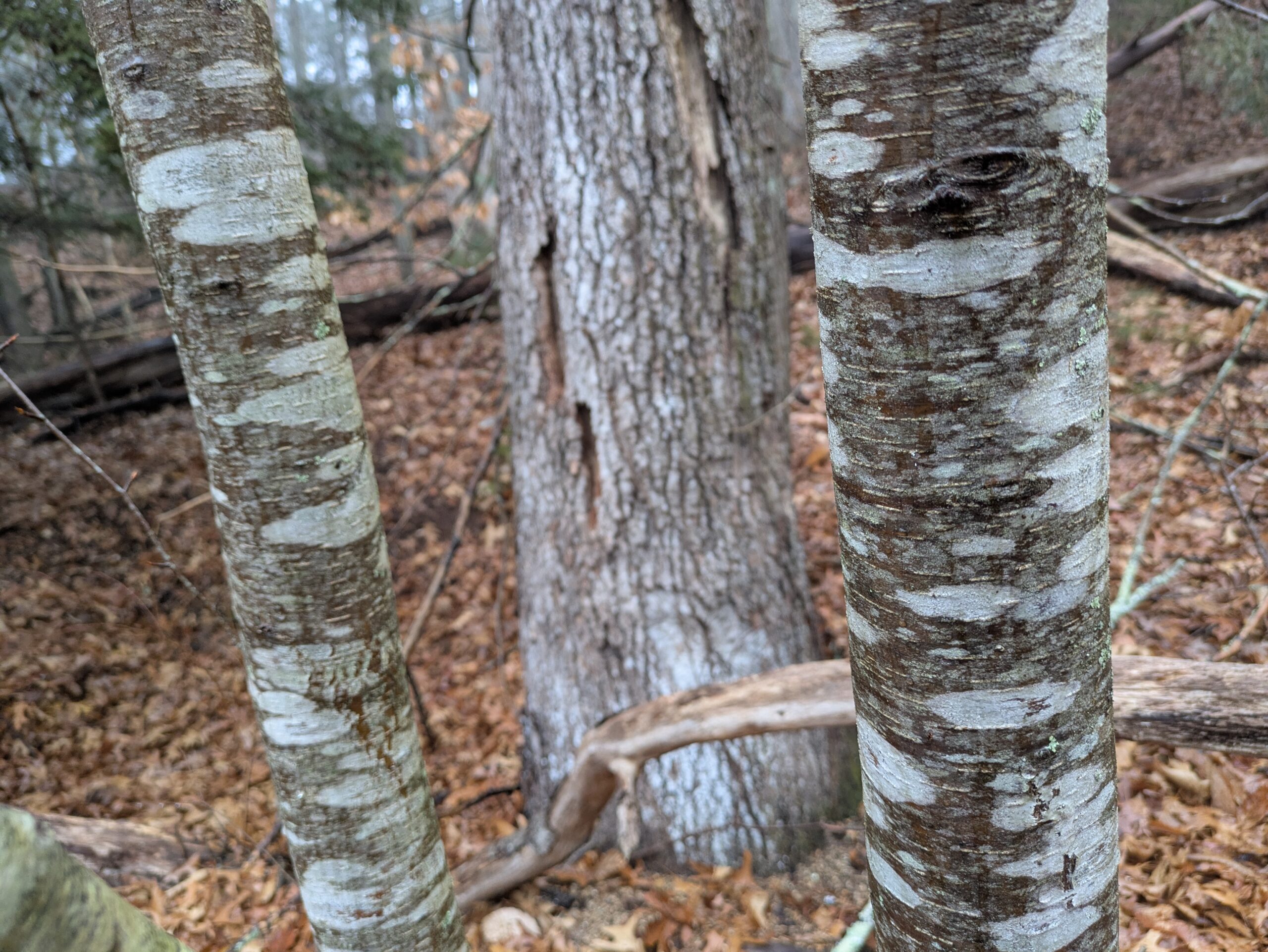
You’re looking for thin sapling specimens mainly, something with small branches you can find and reach. Black birch bark is usually dark grey mottled with white patches, though younger specimens are often just a golden-brown color with very slight horizontal markings on the bark. Give the bark a small scratch with your pocket knife and sniff it–you should smell wintergreen.
Watch my YouTube Video: Identifying young black birch VS Young black cherry
How to Work With Birch Bark Medicinally
Taking bark off the main trunk of a tree is a no-no, unless it’s tree that was recently felled (bad storm, and clearing, etc.) It’s much more sustainable (and quite frankly easier to harvest) to just cut branches from the tree you want. There’s plenty of wintergreen oil in the thin, fresh bark of stems and twigs and the tree won’t mind you trimming a few branches off here and there. [Note: Ask permission first! If you feel a tree say no, abide by that decision and find another.]
I have found black birch, yellow birch (with a papery pale yellow outer bark and brighter yellow inner bark), white birch, and Grey birch in my travels. I’ve made tincture and oil with each one and the verdict is in: Black Birch is the clear winner! Black birch seems to have the strongest scent of all the birches (barring some very young yellow birch saplings I found beside a river once) and it imparts this high Methyl-Salicylate content into whatever menstrum you add it to.

Birch oil is by far the BEST topical pain reliever I have ever found in the herbal world, and my customer reviews back up that claim. As a tincture it can help a headache, backache, or other slight pains but it’s not quite as strong as wild lettuce and not quite as numbing as corydalis.
The older mature Yellow birch made an “okay” oil, but it didn’t have the same scent or strength as the black birch does. However, I must note that if you find a patch of young yellow birch saplings, they do contain the same wintergreen oil and make a wonderful herbal infusion.
Like I said above, I prefer not to harvest white birch even when I do see it because of how endangered it has become in my region. [Note: White birch still grows abundantly further north of here and has a long history of uses with various Native tribes.]
In both the entries for Birch (White and Black) inside John Lust’s The Herb Book (a permanent resident of my bathroom, perfect for toilet learning) it says “an oil similar to oil of wintergreen can be distilled from the inner bark and twigs.” In order to finally find out exactly what this meant, I had to travel to the entry for Wintergreen (Gaultheria procumbens):
The medicinal virtue of wintergreen leaves resides essentially in the oil of wintergreen which can be obtained by steam distillation. The oil consists mostly of methyl salicylate, a close relative of aspirin. Not surprisingly, then, the leaves have long been used for headache and other aches and pains, inflammation, and rheumatism.
~The Herb Book by John Lust
I don’t recommend you put pure essential oil of either birch OR wintergreen directly on your skin, and I have yet to attempt distilling birch twigs to extract this oil or tar. I prefer to make an infused oil, extract, or even a tea with the bark.
The leaves (harvested in spring time) are also lightly analgesic, can help expel intestinal worms, and taste wonderful.

I did a podcast interview last year with Rosalee de la Foret about Birch Trees you can see HERE.
I teach you how I make all my high-powered herbal oils and tinctures inside my Remedies From Nature online herbal medicine making class, and if you ever come Foraging with me I can pretty much guarantee you’re going to taste a birch twig. They make nice toothbrushes and birch beer too!
Book a Foraging Class With Me
This post has been above the various Birch tree species that grow in the Eastern United States. If you have another variety of birch that’s growing local to you, I’d love to hear about how you work with it traditionally or medicinally! Please comment below and tell me.
Please Note: I am not a doctor. This post is not intended as medical advice. Please do not give birch bark or any product made with birch to someone who is allergic to salicylates and do not use birch products on your dog, as it contains xylitol, which is toxic to dogs.