
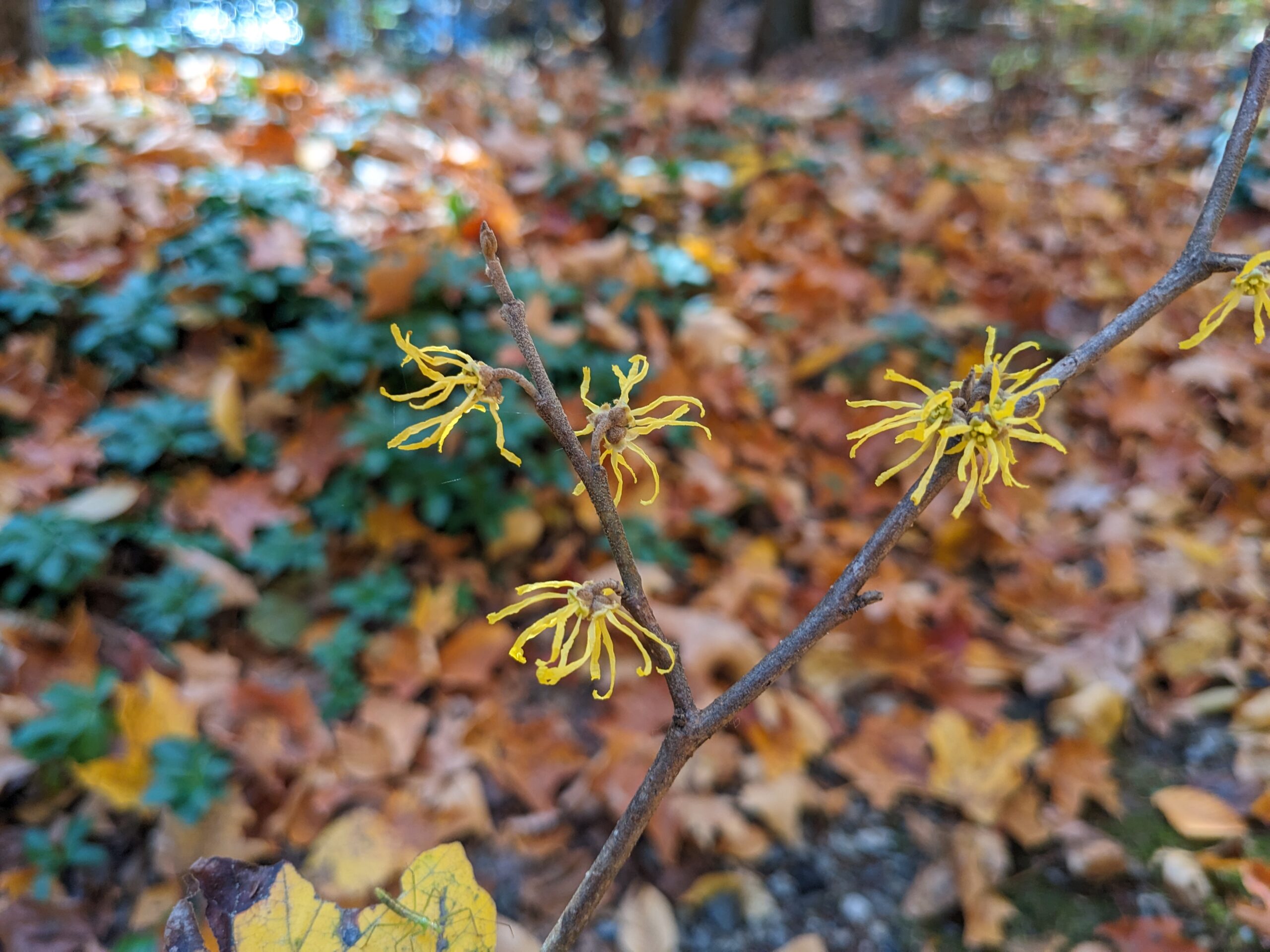
Did you know Connecticut is considered the Witch Hazel capital of the world? [Source]
If you’ve ever stepped onto a wooded trail here, that probably doesn’t surprise you. Witch hazel is everywhere—tucked along stream banks, lining old forest roads, even growing right off hiking paths.
One of my favorite fall moments is catching that faint medicinal scent drifting on the breeze in October or early November. It always feels like the trees are saying, “Hello! Come look at me!”
…and of course, I do.
How to Spot Witch Hazel in the Wild
Once you know what you’re looking for, witch hazel is easy to recognize. Those bright yellow, ribbon-like fall blooms are hard to miss in October. By late November you’ll usually see:
- Yellow, cup-like calyxes still clinging to the branches
- Brown, lumpy seed pods that snap open when dry
- A tall, arching shrub with a slightly crooked growth habit
These are all great indicators you’ve found the right plant.

A Rare Autumn Bloom
Witch hazel (Hamamelis virginiana) is a beautiful native shrub that refuses to play by the rules. While everything else is dropping leaves and calling it quits for the season, witch hazel decides it’s the perfect time to bloom.
Those late-fall flowers also signal something important for herbalists: it’s time to harvest the bark.

Why Witch Hazel Is Such a Powerful Skin Remedy
Witch hazel bark is rich in tannins, which make it a strong astringent. In simple terms, it helps tighten and tone tissues. That’s why it’s such a classic for skin care—I use my own witch hazel extraction every single morning to cleanse my face.
Because of those astringent and anti-inflammatory properties, witch hazel can help support common skin issues such as:
- Acne: Helps reduce oil and tighten pores
- Boils: Soothes inflammation and encourages the bump to calm down
- Hemorrhoids: Eases the itching, swelling, and overall irritation
It’s simple, effective woodland medicine at its best.
Video: How To Harvest Witch Hazel Sustainably

Why I Make an Extraction—Not a Distillate
I’m serious about my witch hazel!
Most commercial witch hazel is a distillate, which means the tannins—the compounds that actually do the astringent work—are greatly reduced.
I make a whole-plant extraction instead. This keeps those tannins intact and results in a much more potent, effective remedy. You can feel the difference on your skin immediately.
Have You Spotted Witch Hazel Where You Live?
If you’ve used witch hazel on your skin—or if you’ve seen it growing near you—I’d love to hear about it. Drop your experience in the comments!
P.S. If you want to try my high-tannin, wildcrafted witch hazel, you can find it here: Wildcrafted Witch Hazel Extract.
And if you want to learn exactly how I make this (and all my other best-selling remedies), check out my Remedies From Nature online class.