
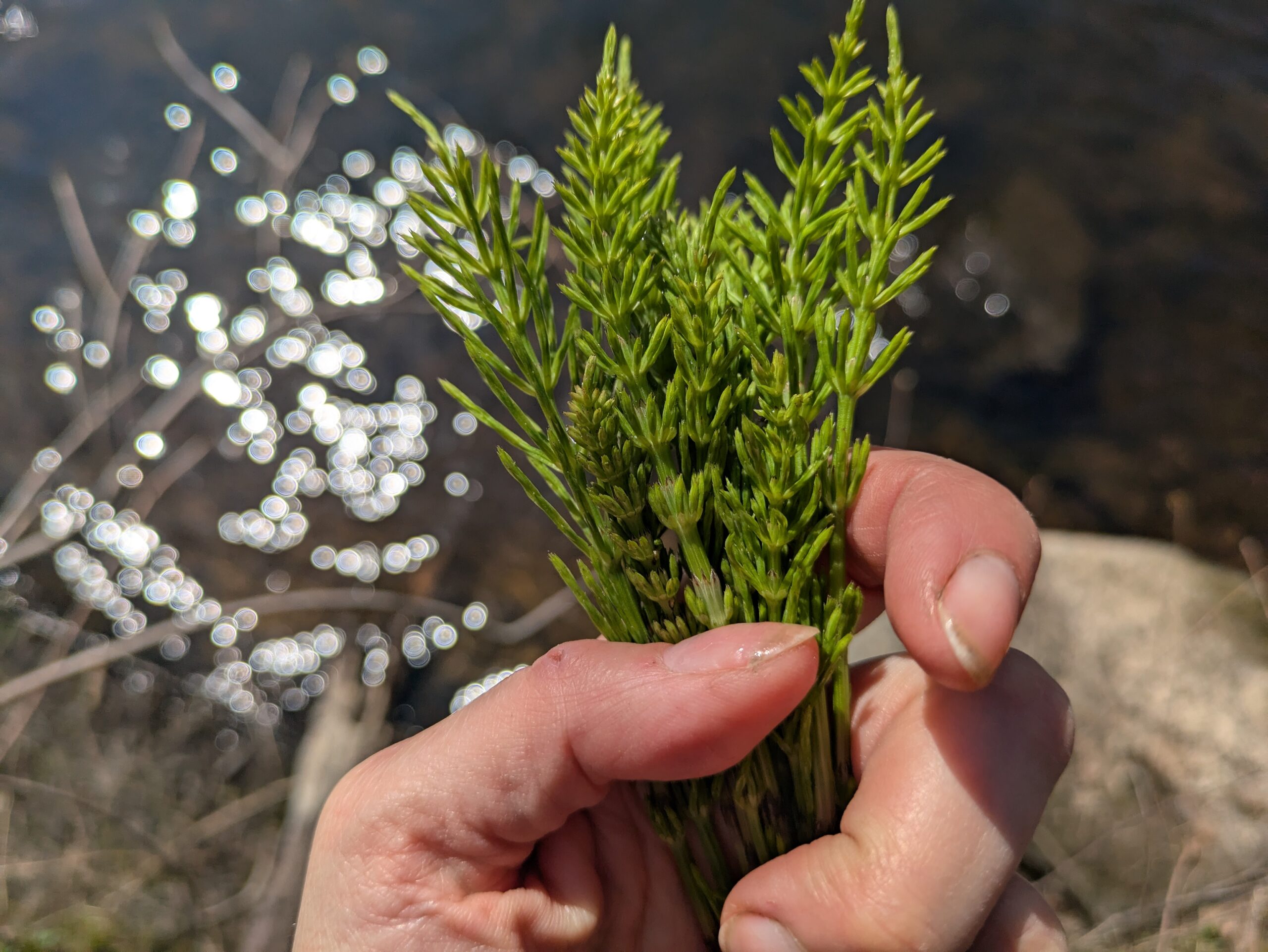
Horsetail is one of the world’s oldest plants, dating back over 300 million years. Many people find it on their property and decide to hate it, as it’s incredibly difficult to eradicate once it has populated an area. But those “in the know” see this wild being as the precious resource it truly is.
There are many varieties of Horsetail but the two I find most commonly are Equisetum arvense (the traditional medicinal variety) and Equisetum hyemale, also known as Scouring Rush.
The first variety has been known to make impenetrable patches of itself in moist areas of lawns and fields. The second variety grows at least 2-3 feet tall and is most often found on riverbanks or near running water. The stems are so stiff that this plant has been bundled up and used to scrub dirty pots and even sand down woodcraft projects!
This plant is super high in Silica and several other trace minerals which are mostly absent from other plants. Because of this, it’s an excellent herb to extract in vinegar (which is my menstrum of choice for extracting vitamins and minerals). You can use this extract as a hair rinse, make it into salad dressing, cook with it, or just take a teaspoon of it several times a week as a supplement.
Silica is one of the building blocks of our bones, hair, and nails, and is frightfully absent from most people’s diets. I add horsetail to any teas I’m making for bone health or rebuilding and also to my oil-pulling oil for swishing, to support tooth remineralization.

This is one of the earliest plants that comes up in the spring and you want to harvest it before the little fronds (the part that make it look like a horse’s tail) have opened up past a 45-degree angle. You’ll want to be splashing around the edge of the water ways hunting and picking in early to mid April (if you’re in New England.)
This plant does warrant a bit of caution, however.
While it can be taken on a short term (2-3 weeks) basis to help kidney and urinary tract infections, long-term use of the plant can actually damage the kidneys. Much like our other friend Comfrey, a certain amount of caution must be exercised with this plant.
I encourage you to explore your boggy fields and riverways the next time you’re out in nature. See if you can find some Horsetail to use as a drinking straw or sand your latest wood project, even if you don’t want to eat any of it.
