
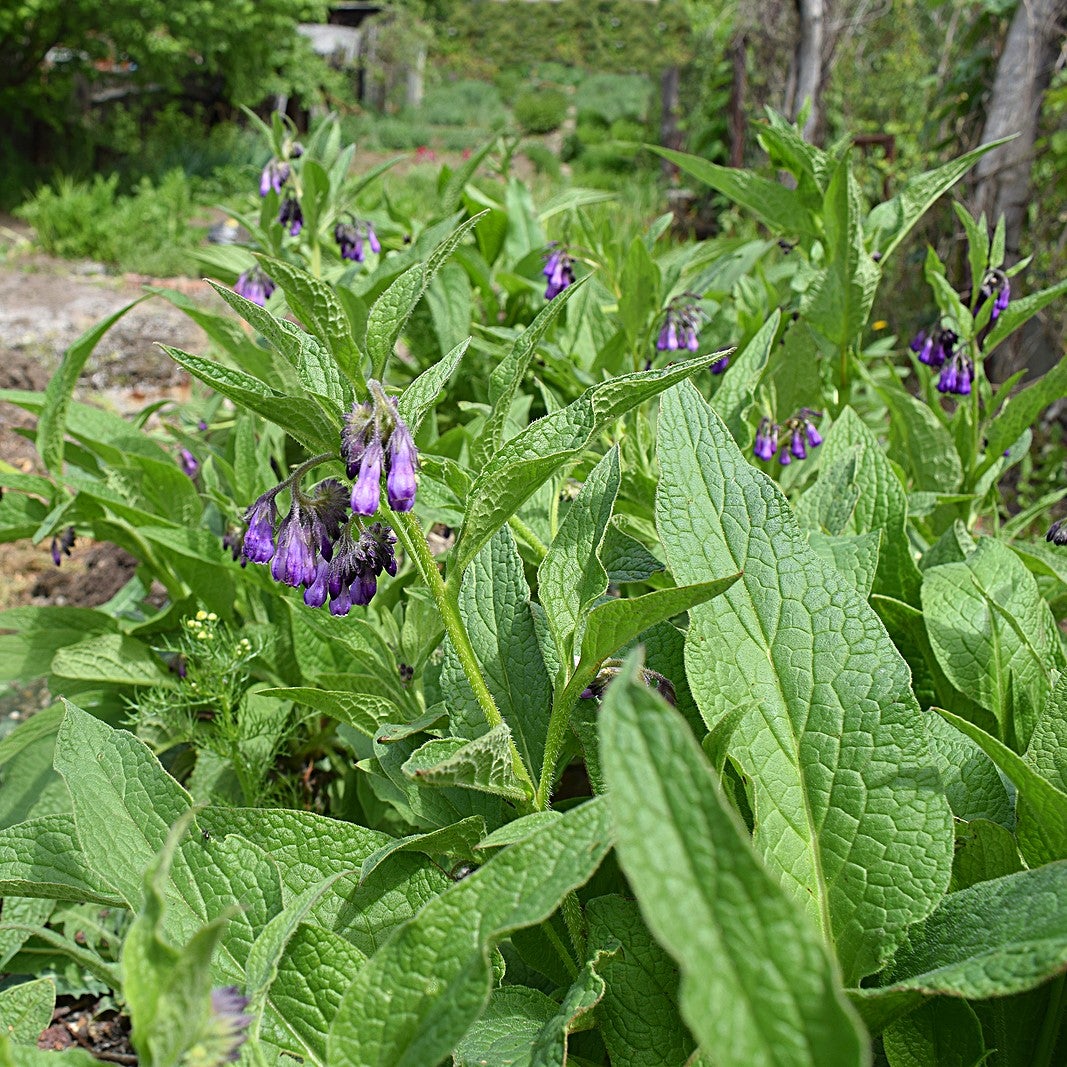
I’m writing about Comfrey (Symphytum officinale) this week partly because so many people asked for it and partly because it really is one of my favorite herbs.

I LOVE how quickly and amazingly comfrey or an infused oil of comfrey heals bruises, sprained ankles, small cuts, or helps mend broken bones.
I (sort of ) HATE how much the comfrey spreads by seed to all parts of my yard and gardens, whether I like it or not.
I learned last year that there is a variety of comfrey you can buy that won’t spread all over the place. Bocking 14 was created in Russia and this plant actually stay where you put it. This would be fantastic if I hadn’t learned it 5 years after I’d planted some around all my fruit trees and let them spread by seed all over my entire yard and every garden.
What parts are medicinal?
I most often work with comfrey leaves, as they are abundant here from April through October and even sometimes into November. The roots of comfrey have the strongest medicinal components, followed by the young fresh leaves, and then the older leaves. This goes not only for the wonderfully helpful constituents like allantoin and mucilage, but also unfortunately for the toxic components called pyrrolizidine alkaloids.
PA’s are what you need to be concerned about, because they won’t hurt you in small or infrequent amounts, but taking them consistently or in high doses can result in irreversible liver damage.
That means you need to be cautious with how much comfrey you dose someone with, especially internally. I usually suggest drinking comfrey tea no longer than 2-3 weeks (if taken daily) to help minimize the buildup of this toxin.
I normally prefer to harvest the younger leaves; not the moment they come out but the sort of middling ones that are bright green and still in good shape, not eaten by slugs or beaten up by the wind. The PA’s are higher in these than the older leaves, but not nearly as high as in the roots. If you work with comfrey roots, please just be cautious with the amount you’re putting into your preparation. A little goes a long way!
What is the benefit to drinking comfrey tea or tincture? If you ever break a bone, you’ll know! Comfrey is just as helpful at healing broken bones (it’s nickname is knit-bone) internally as it is externally. In many cases, the person with a broken bone has that part of their body in a cast. That usually means they aren’t able to apply a poultice or an oil to that area, at least not easily. In this case, having them drink a cup or two of comfrey tea daily will be an immense help!
My friend Virginia broke her leg right before Christmas and as soon as I found out, I mixed her up a healing tea with stinging nettle, comfrey, horsetail, and tulsi. The stinging nettle and horsetail will help give her body the materials it needs to rebuild her bones and the comfrey will help knit the bones back together! The tulsi is in there because it tastes amazing, helps relax you, and is one of my favorite herbs.

Every year, without fail, I make a batch of comfrey-infused oil. This oil has healed my bruises and sprains for years. It can also be used on small cuts and wounds, but don’t put it on major deep wounds as it actually heals skin so quickly that bacteria and dirt can get trapped inside the cut and cause an infection. It’s nickname is knit-bone because a poultice applied daily to an area with a broken bone will help that bone heal much faster.
How do you work with Comfrey?
A few years ago I sprained my ankle in a ditch right outside my back door. After limping back inside the house, I found my jar of comfrey infused oil and applied it all over the swollen leg and ankle. I can guarantee you that oil was the only reason I was able to walk the next day.
This is also why I experimented with infusing it into my oral mouth pulling oil. In May 2023, I was dealing with some pain near my gums from a spot where I had brushed a little too hard for a little too long. I also had two cracked molars on that side of my mouth that were giving me pain, to the point where I started sleeping with a mouth guard every night.
I decided to try oil pulling, as I’d heard a lot about how that could help you mouth. All you really need to do is swish a spoonful of coconut oil around in your mouth for 10-15 minutes every night before you brush your teeth.
But to add a little oomph to my nightly routine, I infused my coconut oil with comfrey leaves, a little horsetail (for the silica to help my bones) and some cloves (antibacterial). I swished every night with this for about two months, then I got a little worried about absorbing too much comfrey into my system through the mucous membranes inside my mouth. So I switched to swishing regular plain coconut oil for about 4 weeks. I’d swish 4 weeks of comfrey oil, 4 weeks of plain oil, on and off, until June of 2024.
In July 2024, I went to see the dentist and had the usual barrage of X-rays taken. At the end of the appointment I asked the dentist, “So, how are the cracks in my molars doing?” I’d almost forgotten to ask, since they no longer hurt anymore.
She looked at the x-ray, looked back at me, and said “What cracks?”
So I think my experiment worked.
How can I learn more about comfrey?
If you’d like to learn even more about one of my favorite herbs, like how to make an incredibly beautiful, dark green, super powerful herbal oil (it took me YEARS to figure out how to do this right!) you can learn that and more in my Remedies From Nature online herbal medicine making class.
Comfrey is also a main component of my best-selling Injury Salve, which you can get in my Online Shop.
I’m getting my butt in gear and making more remedies as fast as I can! Want to come over and help?