
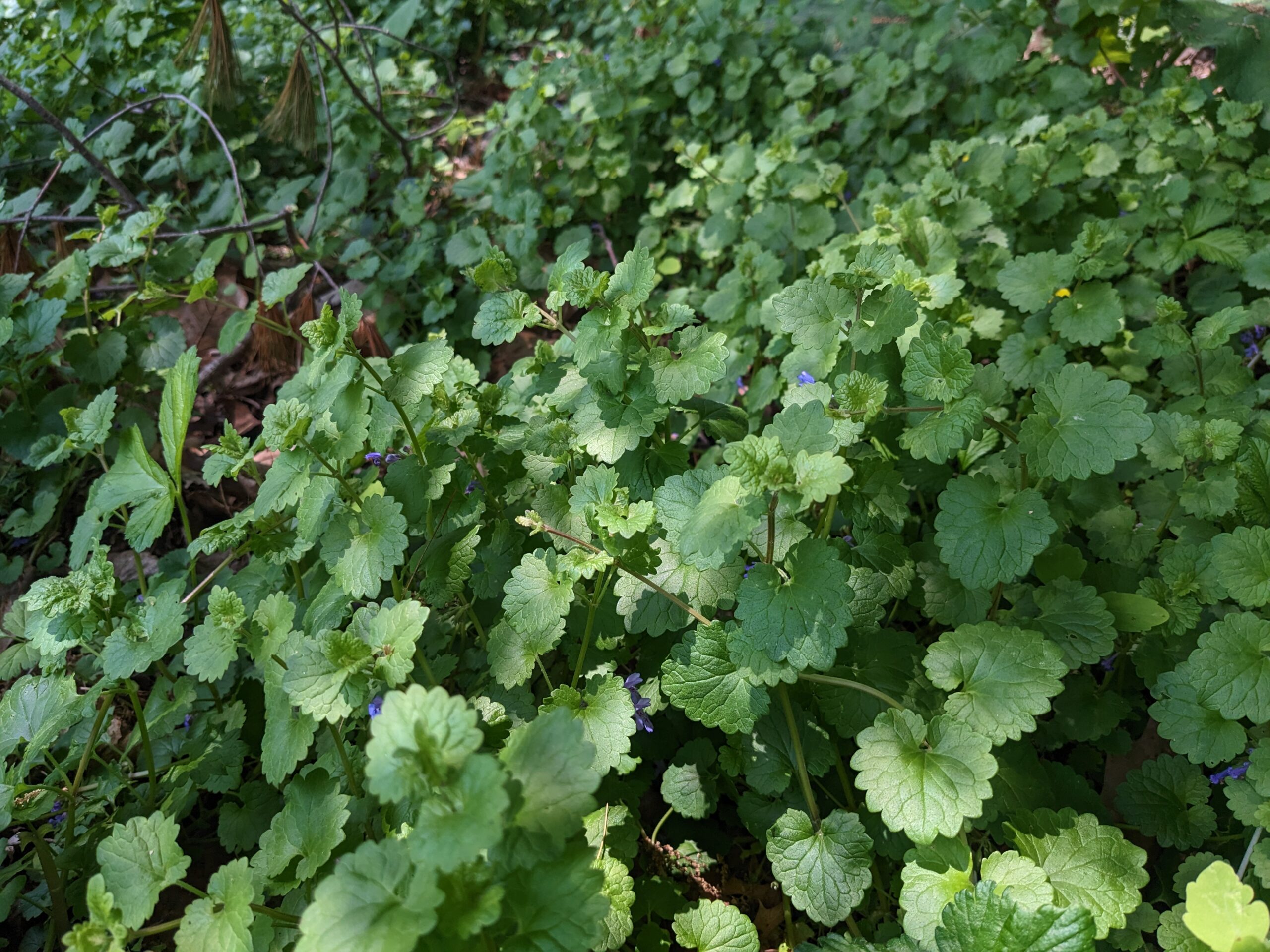
I’ll admit it—I didn’t even know what ground ivy was until about 7 years ago. I heard a podcast episode about it and immediately went in search of this diminutive plant because I heard that it was “better than Mucinex” for mucus overload in your sinuses. Boy, were they right!
What is ground ivy?

Ground Ivy (Glechoma hederacea) is also called Creeping Charlie, Ale-hoof, and Gill-over-the-ground, depending on your geographic location. It’s native to Europe and temperate Asia but was introduced here in New England through colonization and has since become naturalized.
This little herb is one that SOOOO many people seem to hate because it “takes over their yard.” It’s not really “invasive,” but it CAN form large patches in shady or moist areas that are annoying to the kind of person who (for some strange reason) prefers looking only at grass in their yard. Don’t get me started on why I hate the idea of lawns in general. Let’s just focus on finding this cute little guy there.
Herbs WANT to heal you
If you’re just getting “into” herbs, I want to tell you that many herbalists (including me) believe that plants have an innate intelligence that brings them to where they are most needed. If I come to your house teaching a Foraging Walk and spot some in your yard, the first thing I’m going to ask you is “does anyone in the house have a problem with mucus?” I don’t even need to tell you what the plant is before 99% of people I say this to ask me “Yeah, how did you know?”
I’m writing this article right now with a stuffy face full of various stages of wet and dry mucous (I know, what a lovely image I just gave you!) so of course, once I started figuring out that I was sick, I pulled out my Ground Ivy Tincture.
How to Work with Ground Ivy for Sinus Relief
I prefer making this tincture with the fresh leaves and flowers that I harvest in April/May but it also works with the “Second Spring” leaves I sometimes find in October. You can make the tincture with dried plant material but it doesn’t quite taste the same.
If I dehydrate some, I prefer to save it for teas. All you need to do is dehydrate the whole aerial parts (leaves, stems, flowers) until dry and crispy and save them in glass jars. My sneezing, stuffy self just made a lovely mug of tea with ground ivy, bee balm, birch bark, echinacea, and a few coltsfoot flowers and it’s already opening up my congested head.
I have yet to find an herb that will altogether stop the urge to sneeze, but the effect I get from the ground ivy (especially as a tincture) is an immediate drying sensation.
You know when your sinuses are all stuffed up but at the same time you can feel snot starting to drip down the back of your throat or even out your nose? Ground ivy basically dries it all up almost instantly. Yeah, you still to blow your nose, but after a few minutes you can actually breathe again.
It’s also worth noting that ground ivy can be helpful for those suffering with Tinnitus. If your tinnitus (constant ringing in the ears) is being caused by a fluid buildup in your inner ear, which causes pressure on the nerve endings there, ground ivy’s mucous-draining properties may be just the trick to draining the cause out. I have heard several people say they took ground ivy tincture (up to 5 or 6 times a day) and it significantly decreased the ringing they were experiencing.
Nutritional Benefits of Ground Ivy
I personally love the pungent, almost spicy flavor of fresh ground ivy. It adds a nice kick to a spring salad (along with some dandelions, of course!) and the slightly fuzzy leaves add an interesting texture as well.
Ground ivy is high in vitamin C as well as potassium, zinc, iron, and calcium. I love adding some to a springtime herbal infused vinegar along with other nutritive herbs like stinging nettle, horsetail, and red clover. This makes a fantastic tonic in the fall or winter months or a tasty salad dressing over summer greens. Its flavor is pungent and slightly bitter with a little minty aftertaste (it is in the Lamiaceae family, after all).
How to find Ground Ivy
Look in your backyard first! As long as you don’t spray pesticides on your lawn, your yard is the primary source of wild medicinal plants you can utilize. Check the edges of your yard or under the partial shade of large trees.

Where to find it (More resources)
Overall I think the simplest way to work with this herb is as a fresh tincture. Once you pick some of the plant in your yard, you can learn how to make yours the same way I do inside my Making Tinctures Safely and Effectively PDF Guide.
If you’re studying herbalism intently, you can find a more detailed monograph about Ground Ivy and its specific constituents HERE. Because it’s not a primary remedy in the professional herbalism world, if you can’t harvest your own the best place to look for some is various sellers on Etsy. Just make sure they list the correct botanical name.
One final note: please do not ever feel as though you’re failing at being an Herbalist if you give in and take an over-the-counter medicine for your symptoms. It’s okay! Sometimes I need to do that too. Much as I love ground ivy tincture, its effects tend to wear off within 2-3 hours and that just doesn’t help me get through an entire night of sleep. It’s more important that you get the rest your body needs to repair itself than you stick to a rigid herbal rule.
Sometimes I have Ground Ivy Tincture in my Shop. More often than not I don’t have much available since I use it a lot. I add ground ivy to my Allergy Sinus Tincture because it really improves upon the effects of the antihistamine herbs that are stopping the condition my sinuses are in during pollen season. It’s one of my favorite herbal remedies and I keep a bottle in my purse year-round, just in case.
I know it’s going to be one of your favorites now, too!
Comments
2 responses to “Mucus Overload? You Need Ground Ivy”
Thank you – I needed this information.
You’re welcome!