
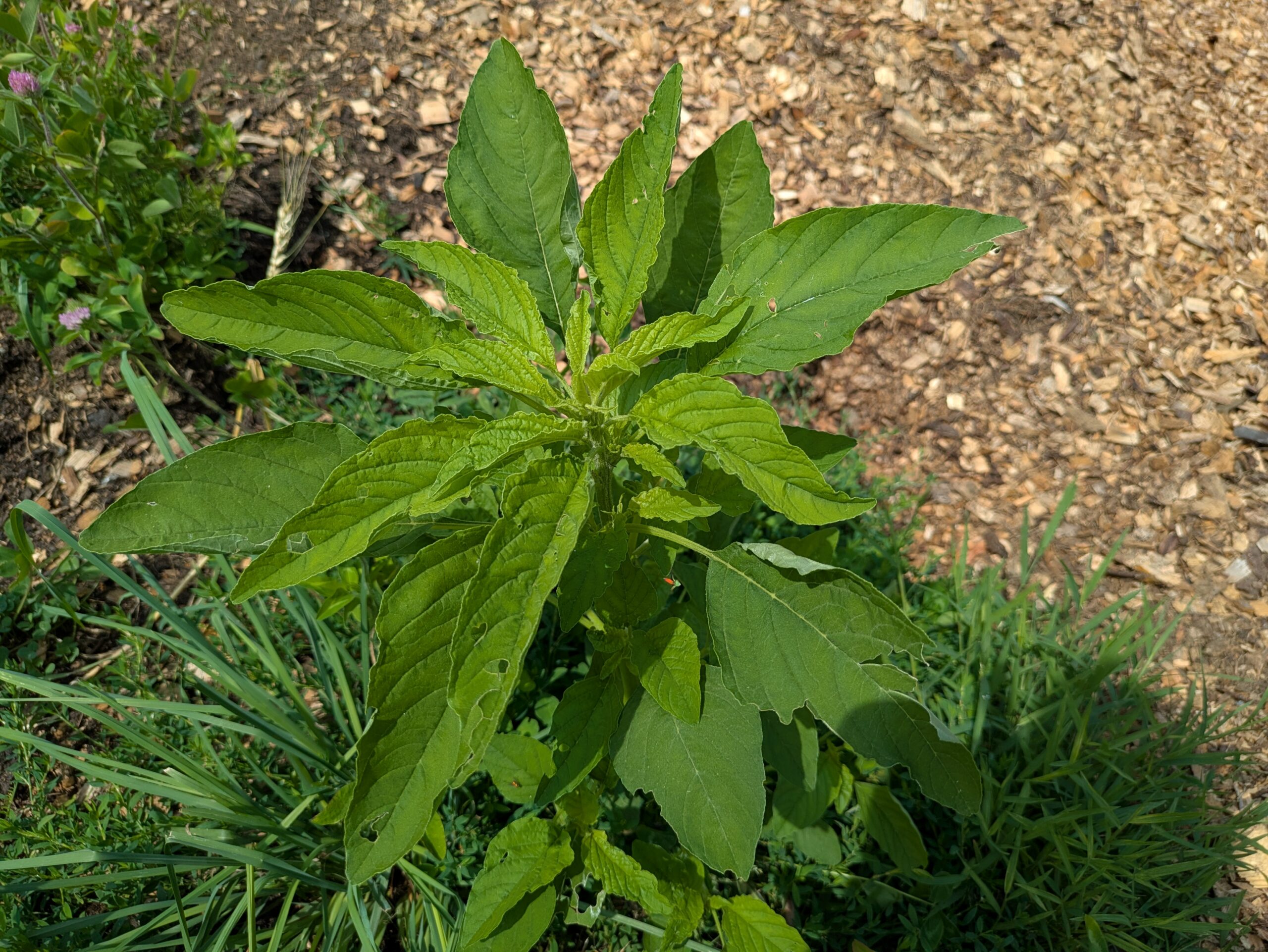
I know I’m seriously narrowing down my niche when I say this, but if you’re a farmer anywhere in the northern part of north America, you’ll likely have said this phrase: F*CK*NG PIGWEED!
I only knew it as Pigweed for at least seven years after I started farming (prior to that the plant had entirely skipped my notice.) But as I worked on more and more organic vegetable farms, we all had the same problem: Pigweed poking through the neat black plastic rows of peppers or strawberries, Pigweed populating the entire carrot bed, and then even spreading to the greenhouse to be extra annoying in the dry heat inside.
Why was it so annoying? Because it has thorns around the top and around the flower/seed head that will whip back and whack you right in the face when you’re struggling to pull this massive thing up.
I didn’t start giving a crap about Pigweed in any way other than I just described until the last few years, when I realized that Pigweed is just a common (rampant) version of Amaranth.
See, when you call it “Amaranth,” it’s pretty and flowery and can be red or yellow and is an abundant source of magnesium, manganese, iron, phosphorous, and multiple other important trace minerals. Even Bob’s Red Mill sells it!
But when it’s Pigweed, it’s green, maybe with a pukey yellow-green flower head, with nearly microscopic black seeds. And it’s annoying as hell.
That is, until you figure out how to eat it.
You see, the best way to eat pigweed amaranth is to eat the young greens. I pick it the same way I pick stinging nettle or lamb’s quarters to eat. Just use your fingers to grab the top 4-6 leaves and fill your basket. You can eat them raw but I prefer them sauteed in butter.
When they’re young like this they don’t have the spikes at the top of the stalk, so they’re easy to manage. Every time to pick a new leaf set, another two sets take its place. You can quickly end up with an amaranth BUSH in your garden!

I will admit now that my attempts at harvesting its seeds have failed so far. They really are SO FREAKING TINY! It’s hard to get the chaff off them plus when you pick up a seed head a million seeds go flying everywhere and it’s not easy to get them collected in one spot (like a paper bag). My last attempt was such a miserable failure that I vowed to not try again until I had a better system (better than throwing it upside down in a paper bag anyhow) in place for harvesting seeds.
However, I have been harvesting the greens for a few years now. They taste and can be used just like spinach. They can be blanched or sauteed lightly and then frozen for winter time. You can dehydrate them to include them in Green Powder for smoothies or salts. They’re seriously delicious.
Amaranth greens are high in Vitamins K, iron, manganese, chlorophyll, copper, and antioxidants. The entire plant is a nutritional powerhouse and I have noticed that if I don’t allow it to get too big, it doesn’t grow the same huge thorns that the ones I used to get whacked with while weeding did.
Most of the time I recommend you eat beef liver to get the kinds of trace minerals that are easily bioavailable in Amaranth greens. These minerals are essential for the movement of iron in your blood as well as for regulating your hormones and growing longer hair.
If you’re reading this and you’re a vegan, you may want to grow Amaranth on purpose if you can, or forage as much as possible. There are few natural sources anymore where humans can easily get the kind of nutrition missing from the modern diet, but Amaranth/Pigweed is one of them. I certainly hope it comes back in my garden this year!
Anyhow, I hope if you are in your garden this year and you spot this pernicious weed, you give it a break and instead of cursing at it, just start eating it. You might even enjoy it!
Sources you can read:
Nutritional and Antioxidant Profile of Amaranth
Note: I do have one affiliate link in here so if you buy Amaranth grain with that link I’ll make a commission. I’m also admitting that I stole two of the photos off the internet and will replace them with originals as soon as July rolls around and I can get good pics of this plant from my own garden. The video is mine though.