
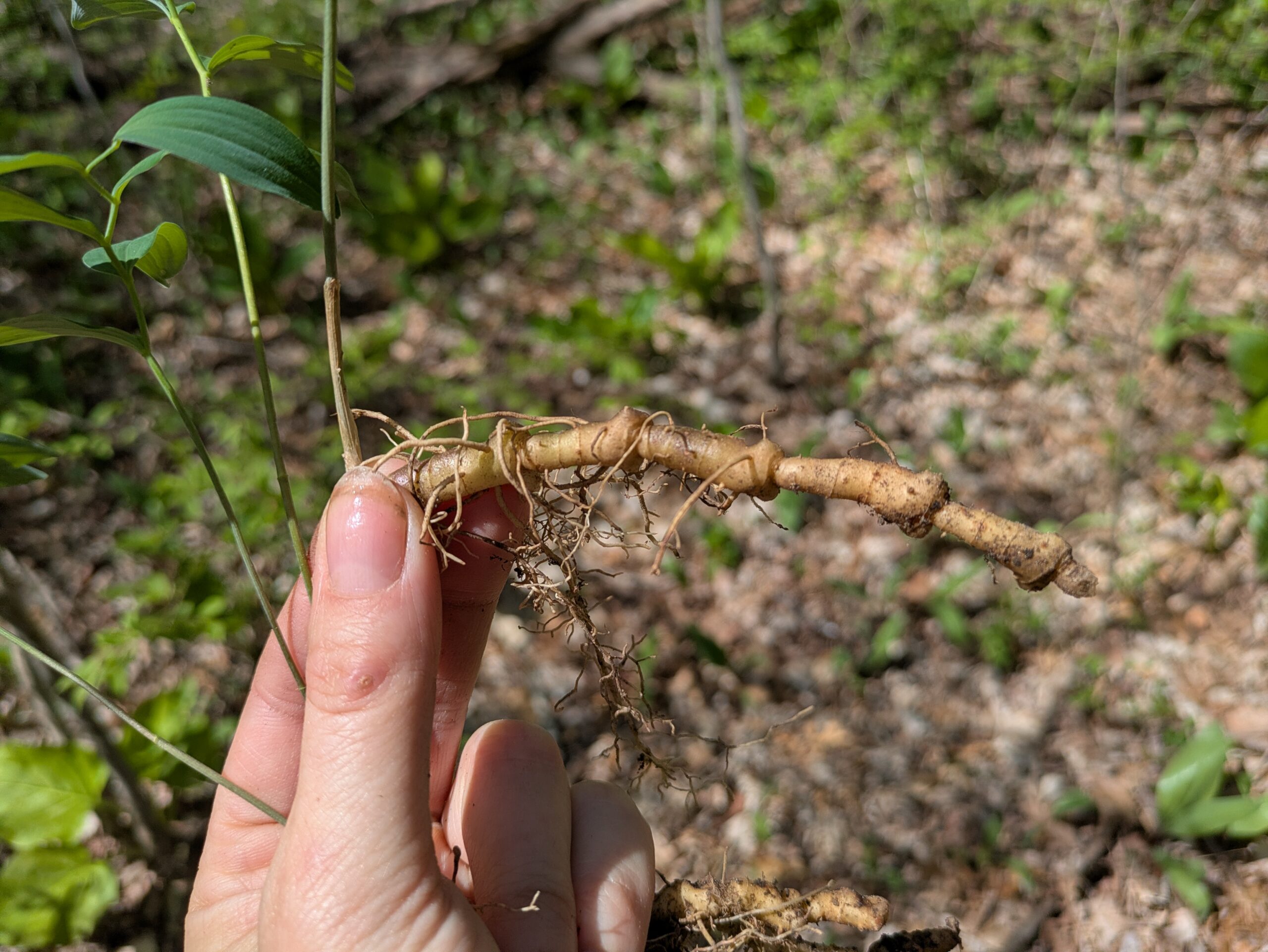
Solomon’s Seal (Polygonatum spp.) is a plant native to the Americas that most people just plant as an ornamental in their garden is by far one of my favorite medicinal herbs. Its unique, bone-shaped roots strengthen bones, marrow, and especially tendons.
Note: I am an Herbalist, not a doctor. This post is not intended as medical advice.
Herbalist Matthew Wood states that the rhizomes of this plant have historical use in curtailing inflammation in the colon due to their oligopolysaccharides that help build up gut flora. [Source] I can certainly attest to their mucilage content, as my hands get really slimy when I’m chopping up the roots to put into the dehydrator.

How do you find Solomon’s Seal?
The easiest way to get a steady supply of this medicinal rhizome is to grow it yourself in your garden, a fairly simple thing to do. The plant prefers to grow in shade or mostly shady areas, especially under the dappled sunlight of a tree canopy above. I mainly find it in deciduous forested areas rather than pine when I forage for it in the wild. You will need to dig up the plant, so if you’re wild harvesting, please be mindful not to harvest too many from any one spot.
An unusual secret about harvesting Solomon’s Seal
In the garden, you can plant it in an area with moist, loamy soil and if you want to give it a head start, cover the area with leaf mulch. You can find the tall variegated variety of Solomon’s Seal readily at many garden centers, as it makes an attractive plant for shade gardens.

Thomas Easley claims this plant is the most reliable remedy for both rheumatoid and osteoarthritis in the entire materia medica. Several other references I found suggested it has been taken for lung complaints, though further research shows this is related to its mucilaginous properties that I mentioned above as helping the intestinal walls.
How do you work with this plant?
For my own apothecary, I work with Solomon’s Seal frequently as a main ingredient in my Injury Salve. It pairs well with comfrey (for bruises, sprains, and broken bones) and birch (an inflammation reducer) and has made my salve one of the best-selling remedies in my Online Shop.
It has helped me heal multiple sprains (on myself and my son), tennis elbow, and has been the difference between needing surgery and just helping the body heal for several of my clients.
My Secret Weapon against injuries
I know I should harvest it in autumn for the best strength, and I can do that in my garden. But for ease of actually finding the plant in the wild, I wait until it’s coming up and flowering, right around early to mid-May. I harvest as many rhizomes as I can and wash, chop, and dehydrate them on a low heat in my dehydrator until they’re completely dry.
I also make a small batch of Tincture with the fresh herb, in case I get hurt or run across someone with a major tendon tear. I’m excited to try it the next time I have a dry, unproductive cough, as my normal go-to for that is either plantain or mullein. But I’ll experiment the next time I feel sick and let you know how it goes!
How can I learn how to do all this myself?
I have been teaching foraging and herbalism for 8 years now and will continue doing so for as long as I can. Inside my Remedies From Nature online class, you get over 80 video and digital lessons on how to find and make herbal medicines with the wild plants that are available throughout the Northeast. I give you detailed lessons on how I make all my powerfully healing herbal oils and other remedies that I sell in my shop.
If you want help putting all this herbal knowledge together, consider signing up to be on the waiting list for my next No BS Herb School or grabbing a copy of my book, Think Like an Herbalist.
Comments
7 responses to “Solomon’s Seal: The King of Herbs for Connective Tissue Problems”
Perfect timing! I just found a bunch in the brush on a neighboring property. Wild garlic too!
Thank you Amelia!
You’re welcome!
I’m so excited to hear your information on Solomon’s Seal I just 3 weeks ago got some transplants for my garden from a friend and then I see you message about using the salve! Thanks !!!
That’s great to hear!
I have Solomon’s seal
After I harvest and dry my roots what is the next step?
I show you exactly how I make all my herbal remedies (powerful healing oils, teas, tinctures, etc) inside my Remedies From Nature online herbal medicine making class! https://www.herbalremediesbyamelia.com/remedies-from-nature